
Advanced · story · Level 5 · 4:56
Advanced Spanish: Solar Impulse’s Global Flight
Watch this episode
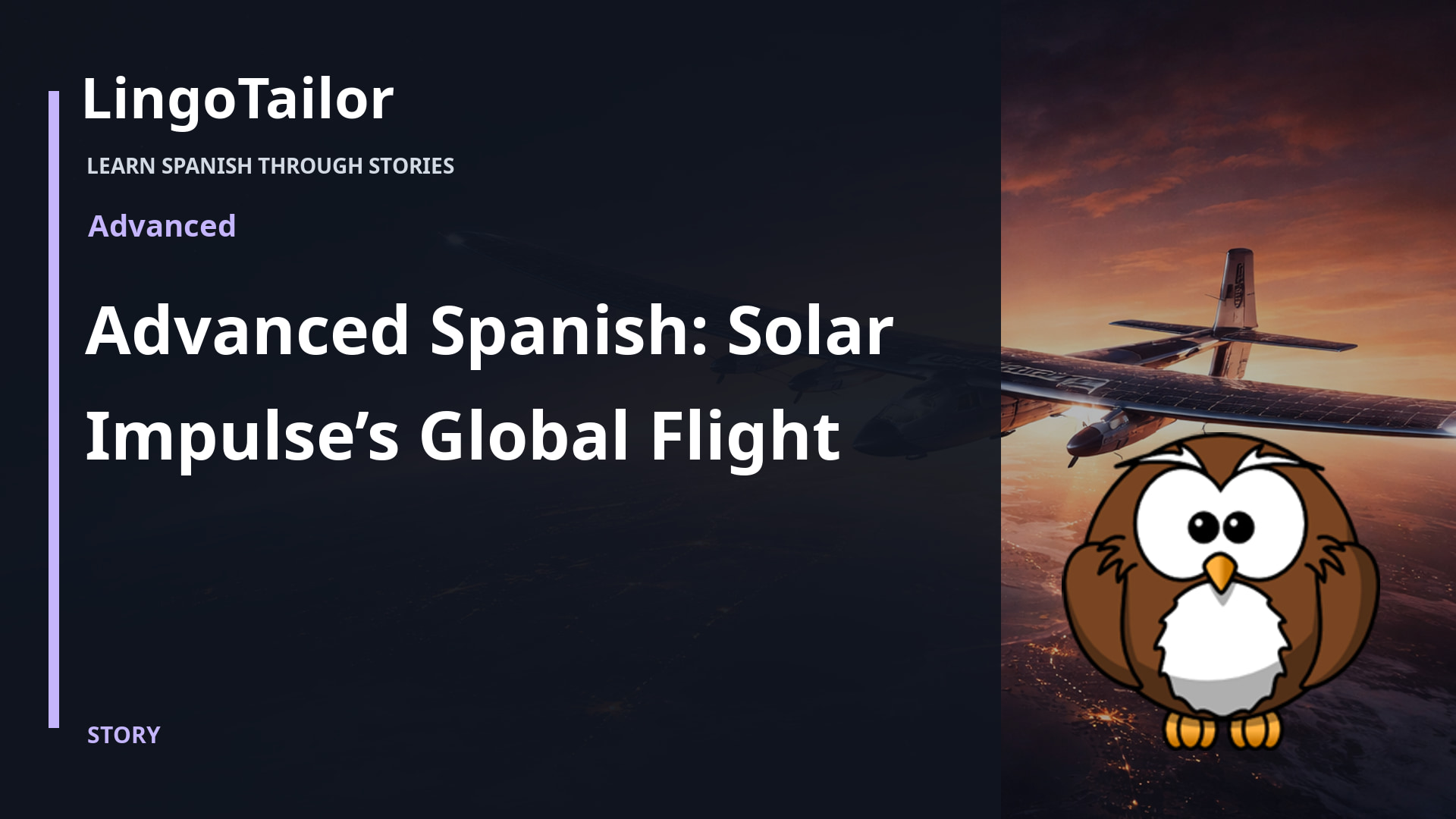
This factual lesson explains how Solar Impulse 2 completed the first circumnavigation of Earth by a solar-powered airplane, while dealing with battery overheating, long ocean crossings, and the limits of stored solar energy.
Story context, sources & AI disclosure
This factual lesson explains how Solar Impulse 2 completed the first circumnavigation of Earth by a solar-powered airplane, while dealing with battery overheating, long ocean crossings, and the limits of stored solar energy. Create your own personalized learning podcast Want a podcast built around your interests and learning needs? Sign up for LingoTailor and create a personalized podcast that evolves as you learn. Register at https://lingotailor.clipiti.com This episode uses AI-generated content and audio and was published automatically, without human review. Language explanations and factual content may contain mistakes.
Account required. A limited lifetime trial is available; your allowance is shown before generation.
Transcript & learning notes
Follow along, pause, and replay the Spanish passages.
EnglishWelcome to LingoTailor, where you learn Spanish through stories. First, you'll hear the story in English to understand the context. Then you'll hear it in Spanish, learn useful vocabulary, and listen to the Spanish story again. Today's story is: Solar Impulse’s Global Flight.
EnglishHere is the English version.
EnglishIn 2015, Solar Impulse 2 left Abu Dhabi to test whether a solar-powered airplane could circle the Earth without using fuel. Pilots Bertrand Piccard and André Borschberg alternated at the controls. The aircraft depended on solar energy: 17,248 photovoltaic cells powered four electric motors and charged batteries for night flight. Its greatest challenge came during Borschberg’s five-day crossing from Japan to Hawaii. The batteries overheated, so the team stopped in Hawaii for almost nine months to redesign part of the cooling system. That delay did not end the mission; it helped the team overcome a serious obstacle. Solar Impulse 2 resumed its journey, crossed the Atlantic, and returned to Abu Dhabi on July 26, 2016. In 17 legs, it covered about 43,000 kilometers. The flight demonstrated the potential of renewable energy in aviation, although the aircraft carried only its pilots and could not match conventional planes in speed or payload.
EnglishNow hear the Spanish version.
EspañolAquí está la versión en español.
EspañolEn 2015, Solar Impulse 2 salió de Abu Dabi para poner a prueba los límites: comprobar si un avión propulsado por energía solar podía dar la vuelta al mundo sin usar combustible. Los pilotos Bertrand Piccard y André Borschberg se alternaron en los controles. El avión tuvo que depender de la energía solar: 17.248 células fotovoltaicas alimentaban cuatro motores eléctricos y cargaban baterías para volar de noche. Su mayor desafío llegó durante el cruce de cinco días entre Japón y Hawái, pilotado por Borschberg. Las baterías se sobrecalentaron, así que el equipo permaneció en Hawái casi nueve meses para rediseñar parte del sistema de refrigeración. Ese retraso no puso fin a la misión; ayudó a superar un obstáculo serio. Solar Impulse 2 reanudó el viaje, cruzó el Atlántico y regresó a Abu Dabi el 26 de julio de 2016. En 17 etapas, recorrió unos 43.000 kilómetros. El vuelo demostró el potencial de la energía renovable en la aviación, aunque el avión solo llevaba a sus pilotos y no podía igualar a los aviones convencionales en velocidad ni en carga útil.
EnglishHere are three useful expressions from the story.
Españolponer a prueba los límites
EnglishTo test how far something can go or what it is capable of, especially under demanding conditions.
EspañolLa nueva tecnología pone a prueba los límites de la eficiencia energética.
Españoldepender de la energía solar
EnglishTo rely on sunlight as the main source of energy, usually with storage needed when sunlight is unavailable.
EspañolEl sistema puede depender de la energía solar durante el día y de baterías por la noche.
Españolsuperar un obstáculo
EnglishTo deal successfully with a difficulty that could prevent progress.
EspañolEl equipo tuvo que superar un obstáculo técnico antes de continuar.
EnglishListen to the Spanish version once more.
EspañolEn 2015, Solar Impulse 2 salió de Abu Dabi para poner a prueba los límites: comprobar si un avión propulsado por energía solar podía dar la vuelta al mundo sin usar combustible. Los pilotos Bertrand Piccard y André Borschberg se alternaron en los controles. El avión tuvo que depender de la energía solar: 17.248 células fotovoltaicas alimentaban cuatro motores eléctricos y cargaban baterías para volar de noche. Su mayor desafío llegó durante el cruce de cinco días entre Japón y Hawái, pilotado por Borschberg. Las baterías se sobrecalentaron, así que el equipo permaneció en Hawái casi nueve meses para rediseñar parte del sistema de refrigeración. Ese retraso no puso fin a la misión; ayudó a superar un obstáculo serio. Solar Impulse 2 reanudó el viaje, cruzó el Atlántico y regresó a Abu Dabi el 26 de julio de 2016. En 17 etapas, recorrió unos 43.000 kilómetros. El vuelo demostró el potencial de la energía renovable en la aviación, aunque el avión solo llevaba a sus pilotos y no podía igualar a los aviones convencionales en velocidad ni en carga útil.
EnglishMake your learning personal with LingoTailor: podcasts adapted to your interests, level, and progress. Practice speaking with ChatGPT, get feedback, and shape your next episode. Follow the link in the description to get started. Subscribe now so you never miss a new episode. Don't just listen to a new language. Start speaking it.