Advanced · story · Level 5 · 5:16
Advanced Spanish: The Workshop in Mainz
Watch this episode
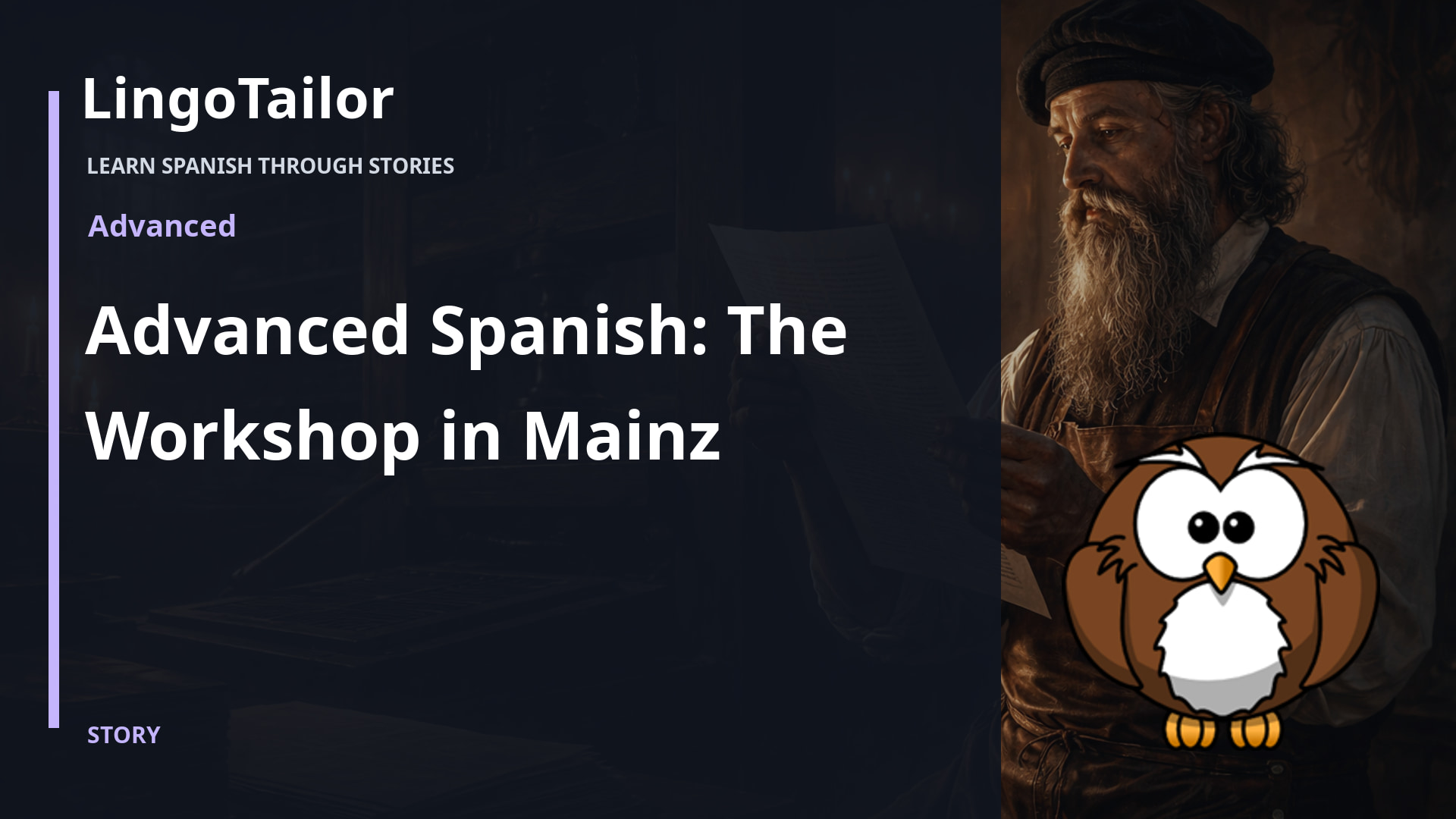
A factual account of Gutenberg’s Mainz workshop: its combination of movable metal type, oil-based ink, an adapted press, and prepared paper; its distinction from earlier East Asian printing; and the financial dispute that affected Gutenberg’s control of the enterprise. The story is based on material from Encyclopaedia Britannica, the Library of Congress, and the British Library.
Story context, sources & AI disclosure
A factual account of Gutenberg’s Mainz workshop: its combination of movable metal type, oil-based ink, an adapted press, and prepared paper; its distinction from earlier East Asian printing; and the financial dispute that affected Gutenberg’s control of the enterprise. The story is based on material from Encyclopaedia Britannica, the Library of Congress, and the British Library. Create your own personalized learning podcast Want a podcast built around your interests and learning needs? Sign up for LingoTailor and create a personalized podcast that evolves as you learn. Register at https://lingotailor.clipiti.com This episode uses AI-generated content and audio and was published automatically, without human review. Language explanations and factual content may contain mistakes.
Account required. A limited lifetime trial is available; your allowance is shown before generation.
Transcript & learning notes
Follow along, pause, and replay the Spanish passages.
EnglishWelcome to LingoTailor, where you learn Spanish through stories. First, you'll hear the story in English to understand the context. Then you'll hear it in Spanish, learn useful vocabulary, and listen to the Spanish story again. Today's story is: The Workshop in Mainz.
EnglishHere is the English version.
EnglishIn Mainz, around 1450, Johannes Gutenberg pursued a practical question: how could texts be reproduced more quickly and consistently than by hand? In his workshop, he combined individually cast metal letters, oil-based ink, a press adapted from existing screw presses, and carefully prepared paper. His achievement was not the invention of printing itself—woodblock printing already existed in East Asia—but a system suited to producing books efficiently in Europe. It was not simply a machine; it was an integrated process capable of producing books on a large scale. Gutenberg and his partners tested the method and adjusted the type and ink until they produced the Bible associated with his name, probably in the mid-1450s. The project was expensive. A financial dispute with Johann Fust led to litigation in 1455, and Gutenberg lost control of part of the enterprise. Unlike a single manuscript, the method made repeated production possible, although each page still required skilled work.
EnglishNow, here is the Spanish version.
EspañolAhora, la versión en español.
EspañolEn Maguncia, hacia 1450, Johannes Gutenberg perseguía una pregunta práctica: ¿cómo reproducir textos con más rapidez y regularidad que un copista? En su taller combinó letras metálicas fundidas por separado, tinta a base de aceite, una prensa adaptada de prensas de tornillo ya existentes y papel preparado con cuidado. Su logro no fue inventar la impresión: en Asia oriental ya existía la impresión xilográfica. No se trataba simplemente de una máquina, sino de un sistema integrado que permitía producir libros eficientemente y a gran escala en Europa. Gutenberg y sus socios probaron el procedimiento y ajustaron los tipos y la tinta hasta producir la Biblia que suele asociarse con su nombre, probablemente a mediados de la década de 1450. El proyecto era costoso. Una disputa financiera con Johann Fust dio lugar a un litigio en 1455, y Gutenberg perdió el control de parte de la empresa. A diferencia de un manuscrito único, el método permitía repetir el proceso, aunque cada página aún exigía trabajo experto.
EnglishNext, we’ll unpack four useful expressions from the Spanish version.
Españolno se trataba simplemente de
EnglishThis expression introduces a clarification: something should not be understood as merely one simple thing, because its significance is broader or more complex.
EspañolNo se trataba simplemente de reducir costes, sino de transformar todo el proceso.
Española gran escala
EnglishThis describes an activity carried out in large quantities or across a broad operation, rather than on a small or individual basis.
EspañolLa nueva infraestructura permitió producir alimentos a gran escala.
Españoldio lugar a
EnglishThis means that one event, condition, or decision caused another event or consequence to occur.
EspañolLa discrepancia dio lugar a una investigación independiente.
Española diferencia de
EnglishThis expression establishes a contrast between two people, things, situations, or outcomes.
EspañolA diferencia de los informes anteriores, este documento incluye datos verificables.
EnglishNow listen to the Spanish version again.
EspañolEn Maguncia, hacia 1450, Johannes Gutenberg perseguía una pregunta práctica: ¿cómo reproducir textos con más rapidez y regularidad que un copista? En su taller combinó letras metálicas fundidas por separado, tinta a base de aceite, una prensa adaptada de prensas de tornillo ya existentes y papel preparado con cuidado. Su logro no fue inventar la impresión: en Asia oriental ya existía la impresión xilográfica. No se trataba simplemente de una máquina, sino de un sistema integrado que permitía producir libros eficientemente y a gran escala en Europa. Gutenberg y sus socios probaron el procedimiento y ajustaron los tipos y la tinta hasta producir la Biblia que suele asociarse con su nombre, probablemente a mediados de la década de 1450. El proyecto era costoso. Una disputa financiera con Johann Fust dio lugar a un litigio en 1455, y Gutenberg perdió el control de parte de la empresa. A diferencia de un manuscrito único, el método permitía repetir el proceso, aunque cada página aún exigía trabajo experto.
EnglishMake your learning personal with LingoTailor: podcasts adapted to your interests, level, and progress. Practice speaking with ChatGPT, get feedback, and shape your next episode. Follow the link in the description to get started. Subscribe now so you never miss a new episode. Don't just listen to a new language. Start speaking it.