
Intermediate · story · Level 3 · 4:38
Intermediate Spanish: Roots and Fungal Networks
Watch this episode
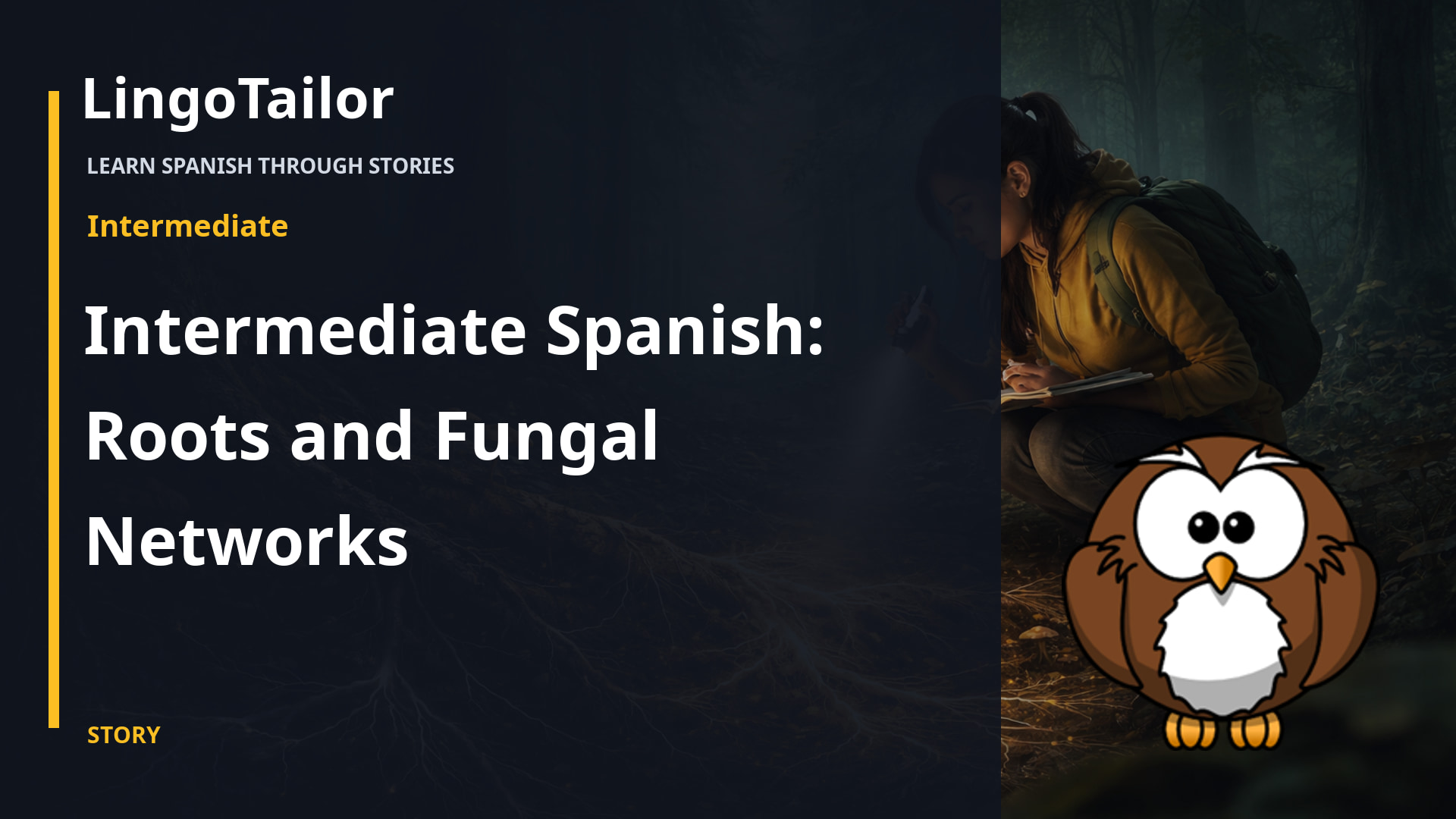
An illustrative scenario follows Maya as she investigates how trees can exchange resources and chemical signals through underground mycorrhizal fungal networks. The explanation distinguishes this scientific shorthand from conscious conversation and notes that these exchanges depend on species, fungi, and environmental conditions.
Story context, sources & AI disclosure
An illustrative scenario follows Maya as she investigates how trees can exchange resources and chemical signals through underground mycorrhizal fungal networks. The explanation distinguishes this scientific shorthand from conscious conversation and notes that these exchanges depend on species, fungi, and environmental conditions. Create your own personalized learning podcast Want a podcast built around your interests and learning needs? Sign up for LingoTailor and create a personalized podcast that evolves as you learn. Register at https://lingotailor.clipiti.com This episode uses AI-generated content and audio and was published automatically, without human review. Language explanations and factual content may contain mistakes.
Account required. A limited lifetime trial is available; your allowance is shown before generation.
Transcript & learning notes
Follow along, pause, and replay the Spanish passages.
EnglishWelcome to LingoTailor, where you learn Spanish through stories. First, you'll hear the story in English to understand the context. Then you'll hear it in Spanish, learn useful vocabulary, and listen to the Spanish story again. Today's story is: Roots and Fungal Networks.
EnglishEnglish version.
EnglishIn this illustrative scenario, Maya wants to answer a question for her ecology class: How can trees share resources if they cannot walk or talk? She learns that many trees live in partnership with mycorrhizal fungi. Fine fungal threads grow around or into tree roots, and they can link several plants into a common network. Through this network, a tree may transfer carbon to another plant and receive minerals or water in return. Scientists have also found evidence that some plants can receive chemical signals connected with defense. However, the direction and amount of these exchanges depend on the tree species, the fungi, and the environment. Maya realizes that saying trees “communicate” is a useful shortcut for describing chemical and physical exchanges. It does not mean that trees have conversations like people. The network may help trees, but it is not a guaranteed underground internet.
EnglishNow hear the same explanation in Spanish.
EspañolVersión en español.
EspañolEn este escenario ilustrativo, Maya quiere responder una pregunta para su clase de ecología: ¿Cómo pueden los árboles compartir recursos si no pueden caminar ni hablar? Aprende que muchos árboles viven en asociación con hongos micorrícicos. Unos filamentos finos de los hongos crecen alrededor de las raíces o dentro de ellas, y pueden conectar unas con otras distintas plantas para formar una red común. A través de esta red, un árbol puede transferir carbono a otra planta y recibir minerales o agua a cambio. Los científicos también han encontrado pruebas de que algunas plantas pueden recibir señales químicas relacionadas con la defensa. Sin embargo, la dirección y la cantidad de estos intercambios dependen de la especie de árbol, de los hongos y del ambiente. Maya comprende que decir que los árboles “se comunican” es una forma práctica y breve de describir intercambios químicos y físicos. No significa que los árboles conversen como las personas. La red puede ayudar a los árboles, pero no es una internet subterránea garantizada.
EnglishHere are three useful expressions from the Spanish version.
Españolconectar unas con otras
EnglishTo link several things or people to each other.
EspañolLas raíces pueden conectar unas con otras en el suelo.
Española través de
EnglishBy means of something, or from one side of something to the other.
EspañolAprendimos sobre el clima a través de un experimento.
Españolno significa que
EnglishIntroduces a clarification that limits or corrects an interpretation.
EspañolTener experiencia no significa que nunca cometas errores.
EnglishListen to the Spanish version once more.
EspañolEn este escenario ilustrativo, Maya quiere responder una pregunta para su clase de ecología: ¿Cómo pueden los árboles compartir recursos si no pueden caminar ni hablar? Aprende que muchos árboles viven en asociación con hongos micorrícicos. Unos filamentos finos de los hongos crecen alrededor de las raíces o dentro de ellas, y pueden conectar unas con otras distintas plantas para formar una red común. A través de esta red, un árbol puede transferir carbono a otra planta y recibir minerales o agua a cambio. Los científicos también han encontrado pruebas de que algunas plantas pueden recibir señales químicas relacionadas con la defensa. Sin embargo, la dirección y la cantidad de estos intercambios dependen de la especie de árbol, de los hongos y del ambiente. Maya comprende que decir que los árboles “se comunican” es una forma práctica y breve de describir intercambios químicos y físicos. No significa que los árboles conversen como las personas. La red puede ayudar a los árboles, pero no es una internet subterránea garantizada.
EnglishMake your learning personal with LingoTailor: podcasts adapted to your interests, level, and progress. Practice speaking with ChatGPT, get feedback, and shape your next episode. Follow the link in the description to get started. Subscribe now so you never miss a new episode. Don't just listen to a new language. Start speaking it.